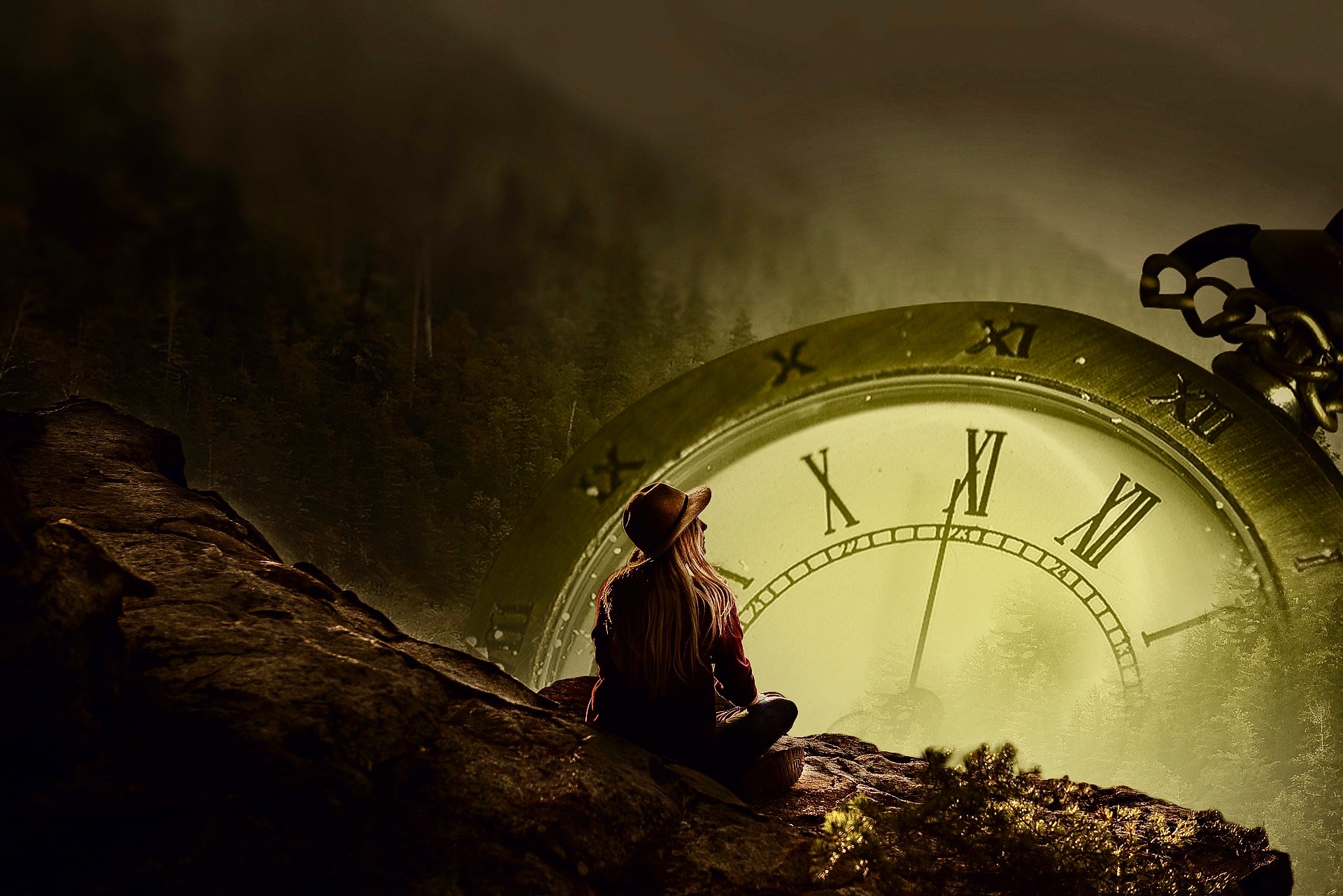
Delving into the philosophy of time in Michael Ende’s ‘Momo’
Reified time and qualitatively lived time
What is time?
It seems to go on forever, yet it also feels like it has an end…
However, one thing is certain: the time given to us is finite. That is why everyone tries to use their time effectively. And so, we pursue the efficiency of time. Perhaps there has never been an era that demands ‘saving time’ as strongly as the present one.
Yet, making time efficient does not necessarily lead to spending time in a fulfilling way.
In a world where time is becoming increasingly efficient every day, are we losing sight of the precious ‘now’? This is the question posed by Michael Ende’s fairy tale, ‘Momo’.
This story depicts a unique philosophy of time for children—or those who were once children.
The ‘Grey Gentlemen’ who appear in the story are symbols of the ‘efficiency of time,’ and they embody a critique of modern time management.
However, this is not all the story asks. As we read further, a more fundamental aspect of time emerges.
It is the conflict between the two faces that time encompasses.
Time appears to us with two faces. There is physical ‘quantifiable time’ and ‘qualitative time,’ which can only be felt as an experience.
And the question truly posed throughout this story is: which of these do we use as the standard for our lives?
Time has an aspect that can be measured by a clock as a quantity. It is time that is divided, calculated, and managed in terms of hours, minutes, and seconds.
On the other hand, time has a qualitative aspect that exists only as an experience. Like a moment spent talking with someone or a moment lost in play, it is time felt by its density rather than its length.
There are calendars and clocks to measure time, but measuring it is of little meaning. As everyone knows, depending on what happens during that time, even a single hour can feel like an eternity, or it can feel like a mere instant. This is because time is life itself. And human life dwells in the heart.
p.83
Time and Capitalism
In the modern age, time is precisely measured and finely managed, and we live within that framework. So, what does this ‘measurable time,’ or quantified time, bring to our ‘lives’?
What Michael Ende asks of us unfolds precisely around this point. What he consistently depicts critically in the story is the equation ‘time = money‘.
Wasting time is foolish. They say time is for saving and preparing for the future.
The Grey Gentlemen repeat:
‘If you save time, you will have more time in the future.’
And they count up (quantify) every hour, minute, and second of wasted time.
As everyone quickly realizes, this logic replaces the basic principle of capitalism—the accumulation and growth of money (capital)—with time, the most universal resource.
The symbol of this is the setting of the ‘Time Savings Bank.’ Time is measured and treated as a ‘thing.’Reified timebecomes an object of trade, promised to be returned with interest if deposited.
But is time really a ‘thing’?
We measure and manage time. However, this has only created a system that treats time like an object, and in reality, time itself has not been materialized. Lost time never returns. This is because time is a qualitative event that appears and disappears with every passing moment.
In the story as well, the time that has been deposited never returns. It is merely transformed into fuel to extend the lives of the men in gray.
This composition depicts the state of our current society in a startling way.
In the name of “improving productivity,” “efficiency,” and “investment,” we are offering up countless “nows” to the future. If we sacrifice the “now,” future wealth will increase—that is the expansion principle of capitalism. However, much of the fruits of that labor are collected for the benefit of corporations, markets, or someone else—countless gray gentlemen—and rarely return as a tangible sense of one’s own “life.”
This paradox of time reminds one of the modern illusion of “delayed gratification.”
Once I achieve financial freedom. Once I have some breathing room. Once the time comes to quit my job. But that “once” is always shifting further away.
What the story of ‘Momo’ points to is a fork in the road between treating time as a quantity or living it as an experience. And that choice is not merely a matter of life skills, but is directly linked to the fundamental question of how humans exist.
Living Qualitative Time
Ende presents “time as quality” in contrast to “objectified” time. The core of Ende’s view of time is condensed in the following passage.
It seemed that no one noticed that by skimping on time, they were actually skimping on something entirely different. No one wanted to admit that their lives were becoming poorer, more uniform, and colder with each passing day.
p.106
But it was the children who were beginning to feel this clearly. This was because there was no longer a single adult who had time to spend with them.
Yet time is life itself. And human life dwells in the heart.
The more humans save time, the thinner their lives become.
Time is life itself—in other words, time is the qualitative experience of “living” that involves feeling, savoring, and being with others. That is precisely why the more we save time, the more “life becomes thin.” Play disappears, conversations shorten, and time for walks or just daydreaming is cut away. As a result, the place where “life” dwells—the heart—shrinks.
What the men in gray are stealing is precisely this qualitative time. By quantifying, materializing, and treating time as a commodity, they sever “time as experience” from human beings.
In the latter half of the story, Meister Hora of the Time Kingdom shows Momo the “flowers of time.” This scene most symbolically depicts the philosophy that time is something to be lived as an experience. Golden flowers that are born and vanish every second. They are each person’s true time, the manifestation of “life” that appears and disappears in every moment.
What is shown here is not an object to be measured objectively, but an existential concept of time that only exists in the “now”. Time is not something accumulated in the future. It is something that can only be lived in the present.
In contrast, the time of the men in gray is “stored” and deferred to the “future.” However, that future never arrives. This is because while they present time as “objectified,” that is merely an illusion they create, showing only one side of time. For time can never be completely “objectified.”
The way Momo finally defeats the men in gray shows us how we can escape this “objectification” of time.
She is asked by Meister Hora to “wait.” In her sleep, she remains in the “here and now” for a year. The men in gray cannot wait. For them, time is either consumed or stored. They cannot bear to place themselves in the pure present.
To wait. To listen. To simply be.
That is the only way not to have one’s time stolen, and at the same time, it is the way to live time most richly—this story seems to be telling us just that.
To the adults who have forgotten qualitative time, and to the children who live it
So, can we live as this story suggests now?
A society where “productivity” and “efficiency” are constantly demanded—
In such an environment, we lament that we ‘do not have enough time’ while being chased by it. We put on gray suits ourselves and demand ‘time savings’ from others—telling them to be faster. And this, in turn, comes back to haunt us. We, too, are told by others—you are taking too much time, finish it in less time.
However, what we must not forget here is that this work is a ‘fairy tale.’ It is, after all, a story told to children.
Why the form of a fairy tale?
It is because even if we know the importance of living qualitatively, we cannot completely escape from a world of quantified time. The reality that we must live within the framework of efficiency and management cannot be denied.
That is precisely why what is needed is not to step outside that framework, but to consciously create ‘time’ to regain, even if only slightly, the sense of living in qualitative time as we did when we were children. It is difficult for adults who have already internalized the logic of the ‘time thieves’ to change their way of life. That is why we must, at the very least, create small fissures.
And I believe this is the meaning of it being told as a fairy tale. It is a story that reminds children of the importance of living in the present, and reminds adults of how precious the childhood era was, when living qualitatively was possible.
Let us try once more, like Momo, to listen to the music of the starry sky.
Without looking at the clock. With notifications turned off.
Not ‘later,’ but ‘now,’ right here.
That is the simplest, and yet the most difficult, time philosophy presented by ‘Momo’.

コメント